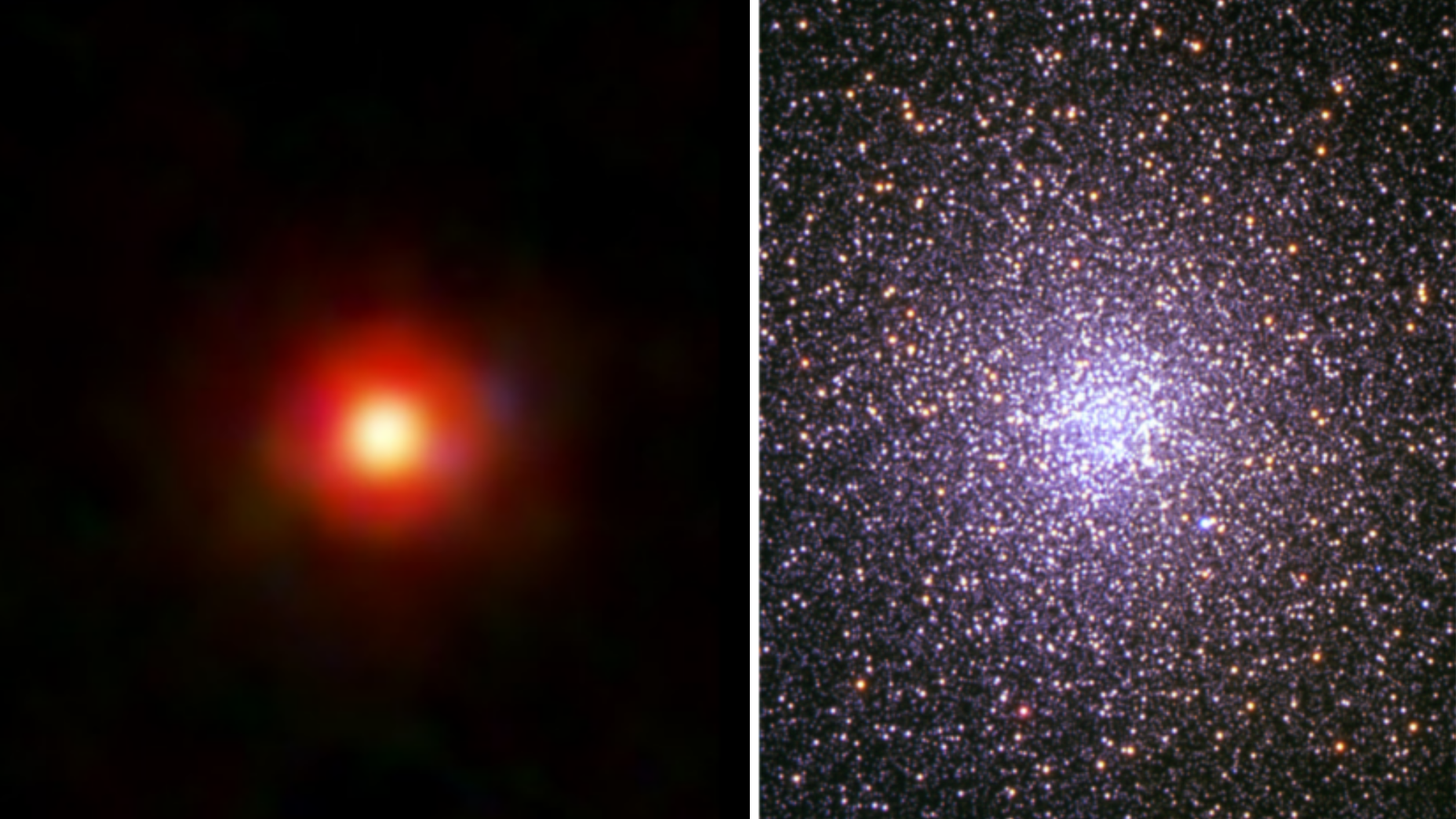
Paleontologists now know that many of the dinosaurs didn’t disappear but instead evolved into modern birds, and new research suggests that “cosmic dinosaurs” observed by the James Webb Space Telescope (JWST) didn’t go extinct either. Rather, they may have evolved into familiar sights in the modern universe: vast conglomerations of densely packed stars called “globular clusters.”
Little Red Dots became quite the puzzle for astronomers in 2022, when the JWST began to routinely spot them in abundance around 600 million years after the Big Bang. That is because these objects seemingly disappear before the cosmos gets to around 2 billion years old.
Astronomers have proposed many different explanations for Little Red Dots, including the suggestion that they could be “black hole stars,” or black holes wrapped in vast shrouds of dense gas and dust. This team theorizes that a forming globular cluster with a supermassive star, a hypothetical short-lived stellar body with between 1,000 and 10,000 times the mass of the sun, would also look a lot like a Little Red Dot at its heart.
“These may not be just a strange new JWST population with no connection to the universe around us today,” team leader John Chisholm of the University of Texas Austin said in a statement. “Instead, Little Red Dots may persist past the early universe, evolving into something relatively familiar.
“Little Red Dots could be galaxies, they could involve black holes, or they could be something even more unexpected. Our work shows that forming globular clusters with supermassive stars should be part of that conversation.”
An unfamiliar side to a familar sight
Globular clusters are generally seen in large galaxies and are densely packed with up to many millions of ancient stars. Our galaxy, the Milky Way, is host to at least 150 globular clusters, and though familiar, astronomers still aren’t quite sure how they form.
“We usually see them [globular clusters] after billions of years of evolution, at a time when their massive stars are gone, their gas has been cleared out, and dynamical processes have changed their masses and structures,” team member Danielle Berg of UT Austin said in the statement. “That makes it very hard to reconstruct the original conditions they formed in.”
It is thought that the stars in globular clusters all formed at the same time in the early universe. However, at this time the cosmos should only have had hydrogen, helium and a smattering of heavier elements (which astronomers call “metals”) available for star construction. Yet, many stars in globular clusters are strangely abundant in helium and metals like nitrogen, sodium and aluminum, while lacking the expected levels of carbon, oxygen and magnesium.
“This specific pattern indicates nuclear fusion at very high temperatures, much higher than in the cores of even massive normal stars,” team member Mike Boylan-Kolchin of UT Austin said in the statement. “A supermassive star is precisely the kind of environment that could produce this combination.”

Supermassive stars capable of generating this kind of heat would form in the dense environments of early globular clusters in which stellar collisions and mergers would be expected to occur over and over again. The resultant supermassive stars would be short-lived, lasting just around 1 million years (remember the sun is middle-aged at 4.6 billion years old) — but this would be sufficient time to forge the elements needed to explain the peculiar chemistry of globular clusters.
When these supermassive stars die in supernova explosions, the elements they forged would be blasted out to become the building blocks of the next generation of stars. This would provide the stars of modern globular clusters with their unusual chemical fingerprints.
“In our model, the supermassive star that helps make the object look like a Little Red Dot would live for only a short time,” Chisholm continued. “Once that star dies, the object may no longer look like a Little Red Dot, even if the cluster itself survives billions of years.”
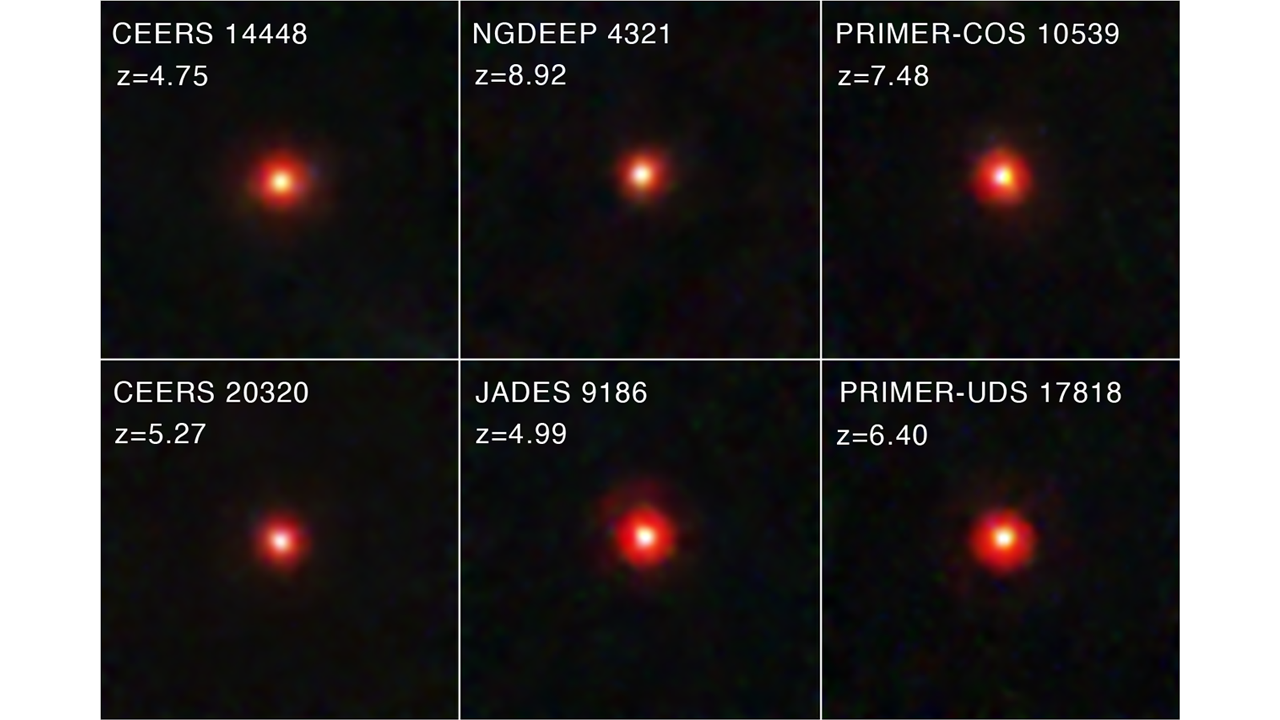
Strange chemistry isn’t the only thing linking early globular clusters with Little Red Dots, however. Not only does the team propose that the distribution of Little Red Dots in the early universe matches the distribution of modern globular clusters, but they also say models of Little Red Dot evolution show that their estimated masses could easily lead to the masses of globular clusters seen in the recent universe.
There is also the issue of timing. Little Red Dots appear around 600 million years after the Big Bang, and that is also the time that scientists estimate that globular clusters would have begun to form.
“There’s no single smoking gun at this point that says Little Red Dots are globular clusters, but it would explain a lot of diverse and surprising observations,” said Boylan-Kolchin.
This study is currently available to view as a pre-print on the paper repository arXiv.