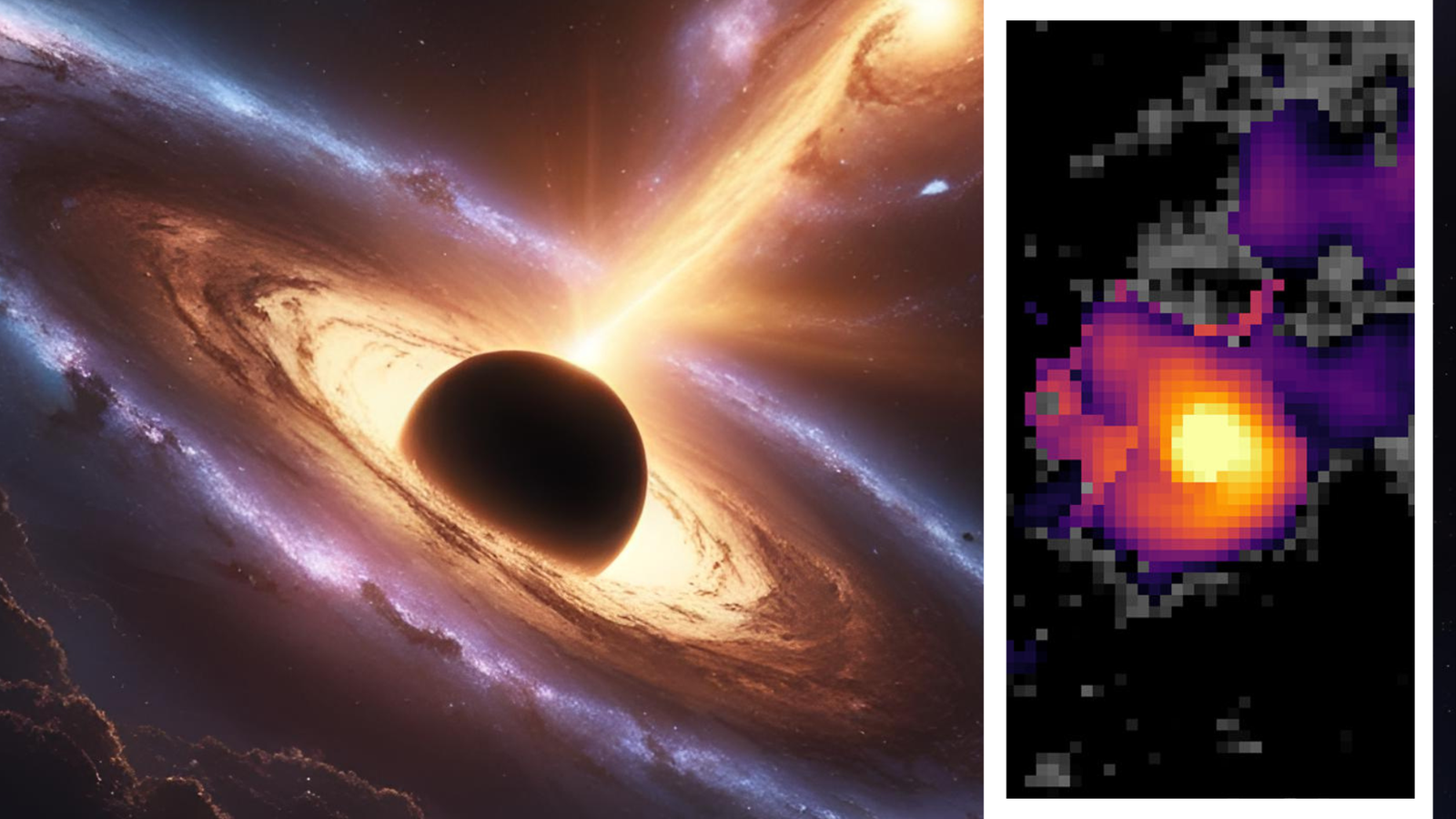
Thanks to the James Webb Space Telescope (JWST), astronomers have been given a glimpse of the mechanisms that supermassive black holes use to feed themselves. The observations could help scientists discover how supermassive black holes with masses millions, often even billions, of times that of the sun grew so fast so soon after the Big Bang.
While all large galaxies have supermassive black holes at their hearts, some are slumbering giants, consuming little surrounding gas and dust, while others are ravenously feeding and acting as the engines of bright central galactic regions called active galactic nuclei (AGN). These feeding black holes also blast matter from their poles in jets that can drive gas and dust — the raw material needed for star formation — out of their host galaxies, thus cutting off star birth and effectively “killing” these galaxies.
Plus, the powerful cosmic titans get really puzzling when astronomers using the JWST spot them before the universe was even 1 billion years old. That’s because the mechanisms by which black holes devour matter to grow and then merge to create even more massive black holes should take at least 1 billion years to achieve supermassive status. This is even more confusing because theories also say the most ravenously feeding black holes (and thus the fastest growing) should also push the matter they use for this growth away, in effect putting themselves on a diet. So, with all this in mind, how did supermassive black holes grow so rapidly in the early universe?
One explanation suggests supermassive black holes push away gas, starving themselves as predicted, but also that this matter eventually cools and falls back to the black hole. That would allow for another period of feeding and thus growth.
This explanation further suggests that as this gas cools down, it forms “streamers,” or filaments, of gas just a few hundred light-years wide but which stretch thousands of light-years long. These would fall back to the center of the galaxy and form a swirling disk around its incumbent black hole, once again feeding it and triggering a new period of growth. This would then restart the jets from the black hole, which would again cut off the cosmic titan’s food supply, allowing the whole process to begin once more.
The process would in essence be a self-regulating cycle of feasting followed by fasting. However, the connection between these filaments and supermassive black holes has been elusive, meaning this mechanism has resisted confirmation.
“What JWST is revealing is that black holes may be the ultimate cosmic recyclers,” team leader Julie Hlavacek-Larrondo of the Université de Montréal said in a statement. “They release enormous amounts of energy that heat their surroundings, yet that same gas can later cool into thin filaments that fall back inward and feed the black hole again. We are finally seeing this self-sustaining cycle in action.”
A dieting supermassive black hole
To solve the mystery of feasting black holes, the JWST turned its attention to a relatively close AGN situated at the heart of the central galaxy of the Centaurus Cluster, NGC 4696, located just 145 million light-years from Earth.
The Hubble Space Telescope previously studied this galaxy, uncovering a strange, hook-shaped swirl of gas near the central supermassive black hole of NGC 4696.
The JWST followed up this discovery by producing a detailed map of gas flowing at the heart of the galaxy. This revealed the hook-shaped feature is around 800 light-years wide and is composed of gas moving at incredible speeds of around 1.3 million miles per hour (600 kilometers per second).
More excitingly, the swirl of gas appears to be connected to a vast filament of material falling in toward the central supermassive black hole.
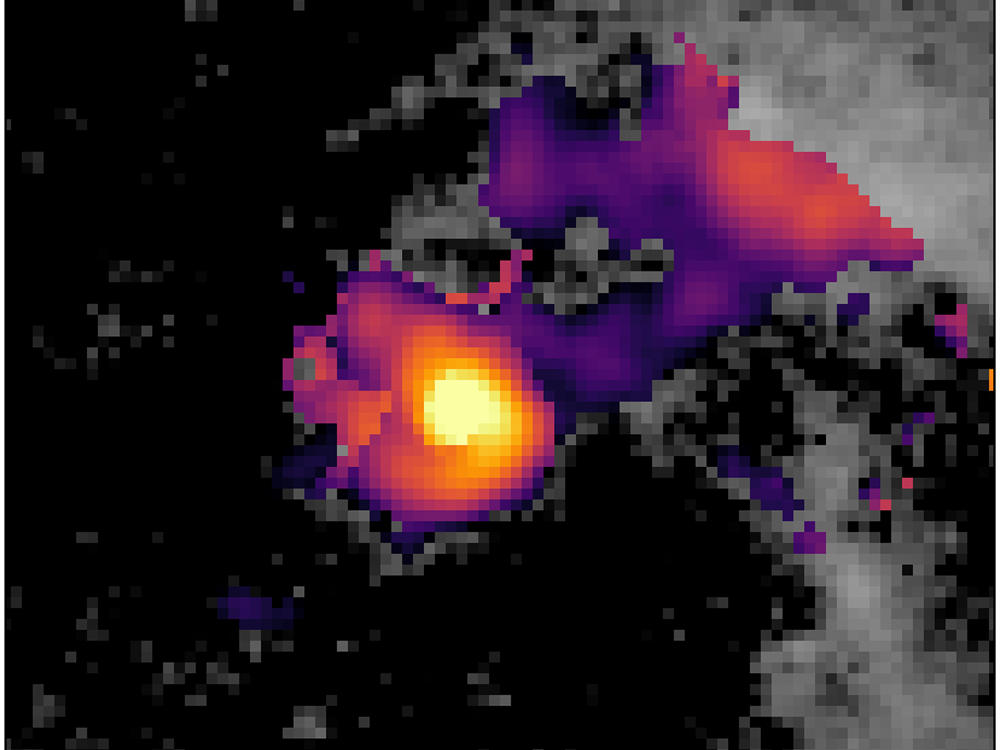
The team tested the JWST observations against a computer simulation, finding gas in the infalling filament scenario would indeed take a shape similar to that seen in NGC 4696.
“JWST is now showing us the final link of this closed loop,” team member Helen Russell of the School of Physics and Astronomy at the University of Nottingham in the U.K. said in the statement. “The vast filamentary network of gas flows ultimately funnels gas down to a disk that fuels the black hole.”
The team’s research was published on Wednesday (July 16) in the Astrophysical Journal Letters.