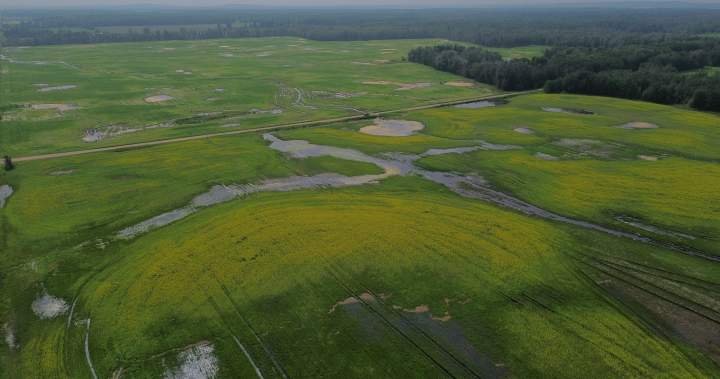
Relentless summer rainfalls has led to two rural counties to declare a state of agricultural disaster north of Edmonton.
Farms in Westlock and Thorhild counties have been drenched by precipitation, leading local politicians to make the calls last week.
The DeWindt family has been farming near the hamlet of Thorhild for decades and the man at the helm can’t recall a summer as wet as this.
“Once that ground is saturated, it’s like a sponge — you just can’t rid of it,” Harry DeWindt said. “It’s draining, but it’s so wet… it’s just unreal.”
Thorhild County declared a state of agricultural disaster on July 17 because of record rainfall in June and a series of intense July storms.
The county said the declaration acknowledges the significant impacts adverse weather conditions have had on farming operations, and also serve to raise awareness with provincial and federal governments about the challenges the agricultural community is facing.
The distance between the Thorhild and Westlock is about 50 kilometres and is scattered with saturated fields.
A saturated canola field on the DeWindt Farm near Thorhild, Alta. on Thursday, July 23, 2026.
Global News
Westlock County council declared its state of agricultural disaster on July 12, citing excessive moisture conditions that have resulted in saturated soils, drowned-out crop acres, forced heading in grain crops, reduced yield potential, and below-average hay and silage production.

Get daily National news
Get daily Canada news delivered to your inbox so you’ll never miss the day’s top stories.
Westlock also acknowledged the declaration does not automatically trigger municipal, provincial or federal funding assistance but does help raise awareness of the struggles farmers are experiencing.
DeWindt, who grows canola, wheat, barley and peas, said at this stage he’s lost 25 to 30 per cent of his crops — but won’t be able to fully assess his losses until he knows what the yields will be like later this year.
The poor growing conditions are bound to have a ripple effect on the local economy. DeWindt admits he won’t be buying any new farm equipment this year because of the overabundance of precipitation.
Some other farmers are reporting crop losses of up to 50 per cent.
A saturated canola field on the DeWindt Farm near Thorhild, Alta. on Thursday, July 23, 2026.
Global News
“This is farming right?” Thorhild County Reeve Trevor Dafoe said. “It’s weather-dependent so we just need some warm, dry weather for a few weeks to help get things back on track.”
Oddly enough, DeWindt suggests if things get worse — it could actually be better for his bottom line, at this point.
“What do we need now? Well to be really honestm I hope we get 100 per cent hail,” he said, explaining more insurance would kick in. “Then we get paid out on every acre, we don’t have to start to combine, no more expenses.
So far, there’s no financial help from the federal or provincial governments.
“We recognize the significant challenges excess moisture conditions have created for Alberta’s agricultural sector in affected regions. These storms have led to a loss of yield, delayed spraying, and made it difficult for producers to move livestock,” said a statement by a spokesperson for Alberta’s agriculture minister.
“Agriculture and Irrigation continues to monitor the moisture and crop conditions for the growing season and regularly communicate with producers, agricultural organizations and commodity groups to get updates on latest concerns.”
The situation is leaving affected farmers to apply for cop insurance, which covers up to 80 per cent of their average yield.
As for consumers, DeWindt points out the prices for wheat and canola are already going up and with waterlogged fields, those prices could rise even further in the coming weeks and months.
— With files from Karen Bartko, Global News
© 2026 Global News, a division of Corus Entertainment Inc.