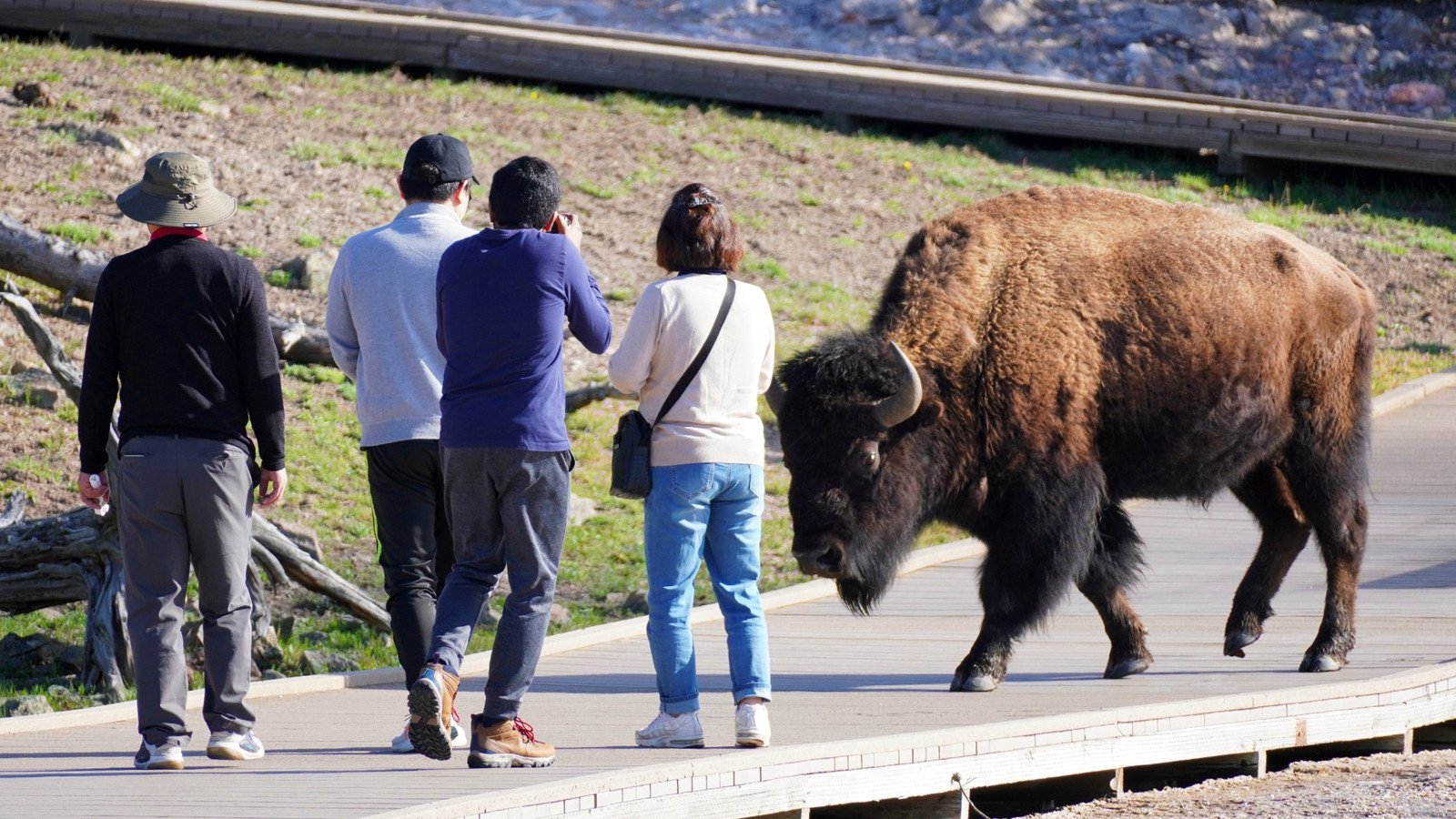
On July 10, a Yellowstone National Park tourist was tossed eight feet in the air by a rampaging bison. Carl Isom-McDaniel, 65, fortunately survived the attack, but it left his femur broken in four places. McDaniel was walking after dinner with his 13-year-old grandson when they spotted the large bison rolling around in the dust.
However, after a driver honked his horn at the animal, it started running toward the pair, tossing the Washington man with its horn. And Isom-McDaniel isn’t the only one who survived: Yellowstone authorities decided they will not euthanize the bison, TMZ reported. From a hospital bed, Isom-McDaniel recounted the bison’s surprising reaction after it charged into him.
Yellowstone National Park Tourist Shares Bison’s Surprising Reaction
In a July 17 video shared by Bozeman Health, a healthcare system that operates two hospitals in Montana, Isom-McDaniel described from a hospital bed how the animal reacted after it tossed him.
He said that the bison could have attacked him more after he was on the ground.
“Even though I was on the ground. He could’ve stomped me, he could’ve gored me, he could’ve done anything,” Isom-McDaniel said.
Mike MacLeod, a photographer who recorded the incident in a now-viral video, also feared the attack would continue after he was tossed.
“I was really afraid he was going to gore the guy on the ground, so I stopped videotaping and ran at the bison, yelled loud, and was trying to be as big and intimidating as possible,” MacLeod told Cowboy State Daily.
However, surprisingly, he said the bison did not attack him further. Isom-McDaniel added that his injuries came from the landing, not from when the bison made contact with him.
“I didn’t get bruises from him launching me in the air; it was the landing that became the problem,” he said.
Isom-McDaniel also recounted what he told his grandson, who was not injured, to get him to safety: “You need to get up to the amphitheater. I will deal with this down here.”
The Rampaging Bison Attack In Yellowstone National Park
According to CNN, the National Park Service (NPS) stated that emergency personnel responded quickly and took him to a local hospital, but he was later transferred to the Montana facility in which he spoke in the Bozeman Health video.
He underwent surgery on July 12 and could stand again the next day.
“I will be doing physical therapy for the next few days to get to walk, but it was not as catastrophic as it could have been,” Isom-McDaniel told CNN.
He delved further in the CNN interview into what happened leading up to the attack. “We were about a hundred yards away,” he said. “He was not aggressive; he was not having problems and we took some pictures and decided to walk on.”
Until a truck drove by the area, which was at the park’s Bridge Bay Campground, and the driver blared his horn in an apparent attempt to get the animal to move, Isom-McDaniel said. That’s when the large bison seemed to get agitated and charged toward him and his grandson.
“There was little time to decide what to do. At that point, he was within 100 yards; he could be to us in seconds, so I told my grandson to run in one direction and I went the other to try and draw him away,” McDaniel said.
The NPS determined that Yellowstone bison were extremely aggressive due to the height of the rutting season, which makes their behavior unpredictable. In Isom-McDaniel’s case, the animal was confirmed to be at its peak during mating season. Meanwhile, this isn’t the only recent incident of a bison attack at the park.
Another Incident Of A Bison Attacking A Tourist At Yellowstone
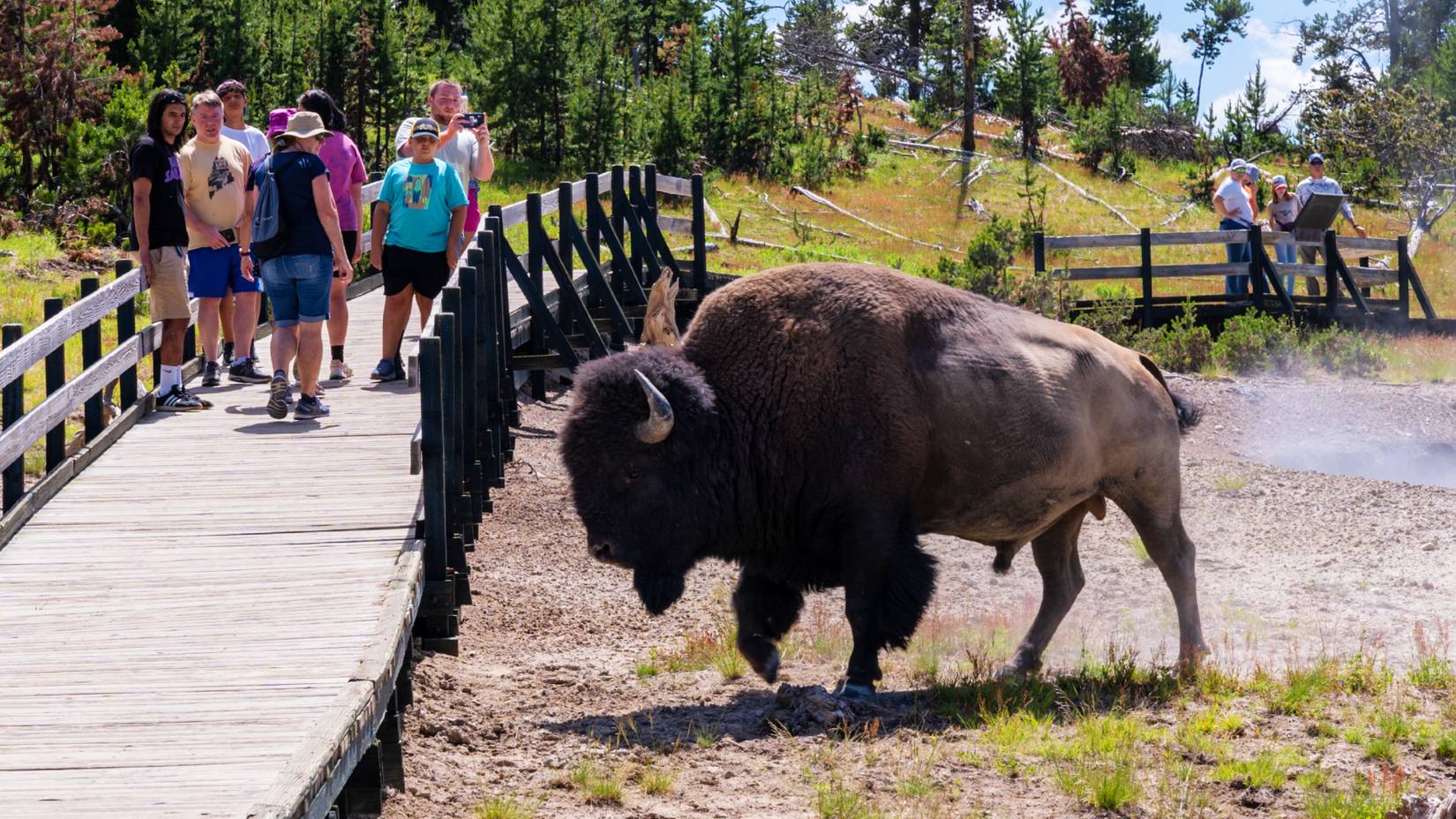
On the morning of June 26, a 12-year-old visitor was injured by a bison in Yellowstone, according to the NPS. The agency stated that the incident happened near Mud Volcano, north of Fishing Bridge. The NPS confirmed that the child was transported to a nearby hospital. “The incident remains under investigation,” the agency stated at the time.
Bison injuring visitors in Yellowstone is more common than any other of its wildlife, the NPS has said. “Bison have injured more people in Yellowstone than any other animal. They are unpredictable, can run three times faster than humans, and will defend their space when threatened,” the agency states.
The NPS also states that the animal, whose 2025 estimate placed its Yellowstone population at nearly 5,300, can run up to 30 miles per hour. In the press release about the June 26 incident, the NPS added an advisory for visitors on how to act near Yellowstone’s wildlife.
“Wildlife in Yellowstone are wild and can be dangerous. Wild animals can be aggressive when people do not respect their space. Visitors are responsible for staying at least 25 yards away from all large animals, including bison, elk, bighorn sheep, deer, moose and coyotes, and at least 100 yards away from bears, wolves and cougars. If wildlife approach you, move away to maintain the required distance. Never approach, touch, feed or crowd wildlife, even if an animal appears calm.”
Although bison attacks in Yellowstone are rare, with the last fatal incident being in 1983, visitors should still proceed with caution and follow the NPS’ tips for staying safe.